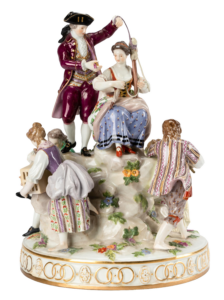
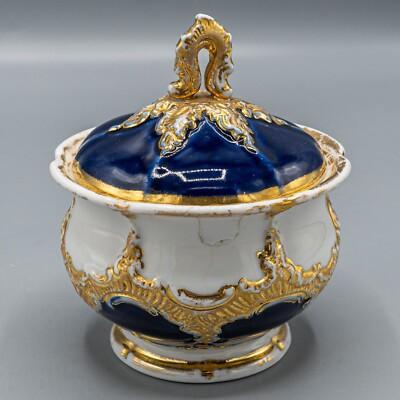
Why not every piece of Meissen porcelain has high market value?
For decades, Meissen porcelain has functioned in owners’ awareness as a synonym of luxury, prestige, and “secure value”. The crossed swords mark is often treated as a guarantee of price, and the name Meissen alone is enough for financial expectations to rise sharply.
The collectors’ market, however, is far more selective. For professional buyers, Meissen porcelain is not a single homogeneous category, but a complex field in which value is determined by nuances: era, form, model, quality of painting, and real rarity. As a result, a large proportion of objects “from Meissen” remain in the decorative segment rather than the collectors’ one.
What is Meissen porcelain in the context of the collectors’ market
Meissen is the oldest European hard-paste porcelain manufactory, whose production began in 1710. From the market perspective, however, it is not a brand in the modern sense, but a historical production system spanning more than three centuries.
The market distinguishes three basic categories:
- historical porcelain of collectors’ significance,
- decorative porcelain,
- utilitarian porcelain with mainly aesthetic value.
The mere fact that an object was produced in Meissen does not automatically determine its market position. What matters is when, how, and in what context it was made.
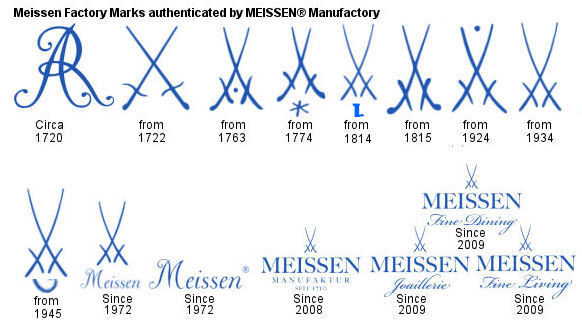
What truly increases the value of Meissen porcelain
Production era
The highest value is attributed to 18th-century and early 19th-century porcelain. The closer to the beginnings of the manufactory, the greater the significance of the object—provided it has preserved its original technological and stylistic characteristics.
Later production, especially mass output from the late 19th and 20th centuries, rarely reaches comparable price levels.
Form and model
The market favors:
- sculptural models,
- figures with complex structure,
- elaborate figural groups,
- forms designed by renowned Meissen modelers.
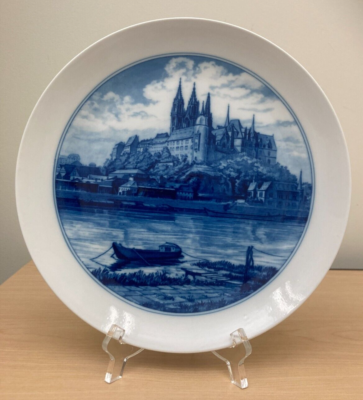
Simple plates or cups, even old ones, usually remain in the decorative segment.
Quality of painting
Hand-painted, master-level decoration with high precision, consistent with the era and model, is of great importance.
Repetitive floral decorations or schematic scenes reduce market attractiveness, even with a correct mark.
Condition
Meissen porcelain is judged mercilessly in terms of condition.
Cracks, restorations, retouching, replacement of elements, or even small chips can reduce value by several dozen percent.
The Meissen mark – why it is not enough
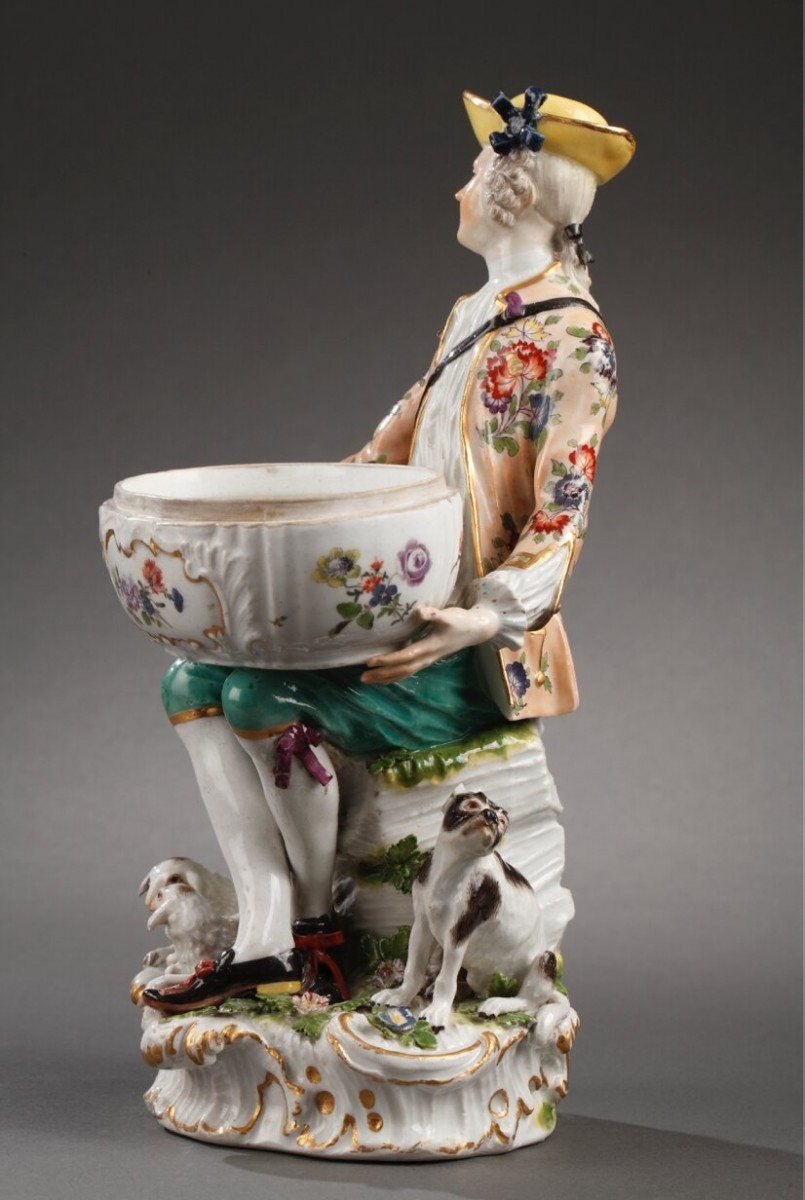
The crossed swords are one of the most recognizable marks in the history of craftsmanship, but also one of the most frequently misinterpreted.
The mark changed over different periods, was used in various variants, and is not always a clear dating indicator. Moreover, the market knows a vast number of objects secondarily marked, supplemented, or wrongly attributed.
The mark alone, without analysis of form, porcelain mass, painting style, and firing technology, is not proof of high value.
What most often reduces the value of Meissen porcelain
Mass production
A large portion of 20th-century porcelain was produced for the decorative market. It is correct and aesthetic, but common—and commonness does not build price.
Restoration and “refreshing”
Cleaning, filling losses, repainting, or gluing performed outside museum-grade conservation almost always lower market value.
Incorrect attribution
“Old”, “family-owned”, “certainly 18th century”—without confirmation these remain hypotheses.
The market treats such declarations as risk.
Most common owner myths
- “Because Meissen is always expensive”
- “Because it has a mark”
- “Because I saw something similar in a museum”
- “Because it is a set”
- “Because it is old”
The market does not price beliefs, but comparable transactions and real demand.
How the market actually values Meissen porcelain
- Auctions analyze comparability of models and periods.
- Dealers focus on the possibility of further resale.
- Collectors seek specific forms and eras.
Asking price is not market price.
What matters is what the object can achieve in a real transaction.
When a professional appraisal makes sense
- before sale or consignment to an auction house,
- in estate division or inheritance matters,
- for insurance purposes,
- when deciding whether to keep or sell,
- when an object has potential collectors’ value but is not unequivocal.
Expert summary
Meissen porcelain is not a single value category.
Mark, form, and era must work together for an object to have real market potential.
This cannot be assessed “by eye” or based on family narrative. The market pays for quality, rarity, and the ability to defend the object in future resale.
If you own Meissen porcelain and want to know whether it has collectors’ value or only decorative significance, at ArtRate.art we focus precisely on this kind of fact-based analysis.