How They Differ and When Each Makes Sense
In the art and antiques market, the terms valuation and expert opinion are often used interchangeably.
In practice, however, they refer to two different types of assessments, with different scope, purpose, and formal consequences. Understanding this distinction is crucial both for object owners and for those using professional services.
Below we explain how valuation differs from expert opinion and in which situations each of them applies.
What Is a Valuation?
A valuation is a market-oriented assessment whose purpose is to determine the approximate value of an object at a given moment, taking current market conditions into account.
A valuation is based on:
identification of the object,
analysis of authorship or attribution (where possible),
assessment of condition,
comparison with market results,
analysis of trends and demand.
The result of a valuation is usually a value range rather than a single fixed amount. A valuation has an informational and decision-making character — it helps the owner understand the market potential of an object, but does not constitute legal confirmation of authenticity.
What Is an Expert Opinion?
An expert opinion is a specialist assessment whose purpose is to determine as clearly as possible:
the authenticity of the object,
authorship or circle of origin,
time and place of creation,
technology and materials,
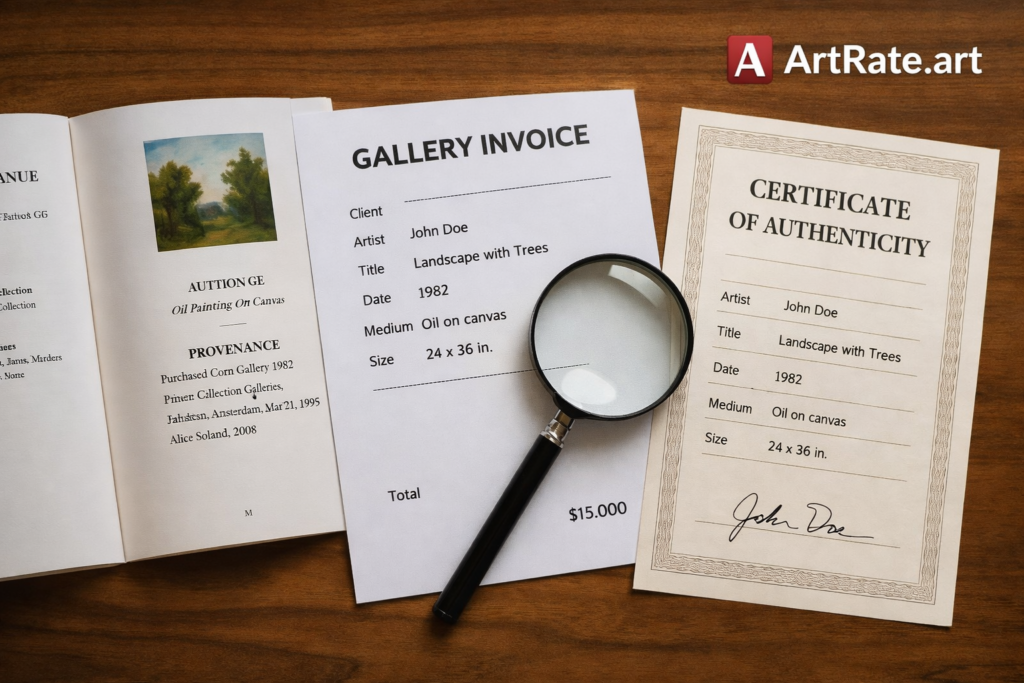
the history of the object (provenance), where available.
An expert opinion requires:
in-depth comparative analysis,
knowledge of the output of a specific artist or workshop,
often technological or conservation research,
the expert’s responsibility for the issued opinion.
Unlike a valuation, an expert opinion does not have to include a price — its primary purpose is to establish facts.

Key Differences
Valuation:
focuses on market value,
has an indicative character,
takes market volatility into account,
does not determine authenticity,
serves decision-making.
Expert opinion:
focuses on authenticity and attribution,
has a specialist character,
is based on expert knowledge and research,
is sometimes used in formal proceedings,
carries greater responsibility for the author.
When Is a Valuation Sufficient?
A valuation is sufficient when:
the sale of an object is planned,
the owner wants to know the approximate market value,
decision-making information is needed,
the object does not require formal confirmation of authenticity.
In such cases, a valuation allows for a rational assessment of the object’s potential without engaging in lengthy and costly procedures.

When Is an Expert Opinion Required?
An expert opinion makes sense when:
the object may have high potential value,
a sale through a reputable auction house is planned,
the object is subject to dispute, inheritance, or insurance,
formal confirmation of authorship or authenticity is required.
An expert opinion is a more complex and time-consuming process, but in certain situations indispensable.
Limits of Responsibility
It is worth emphasizing that:
a valuation does not replace an expert opinion,
an expert opinion does not guarantee a sale price,
both assessments have different purposes and scopes of responsibility.
A clear distinction between these concepts helps avoid misunderstandings and false expectations.
Summary
Valuation and expert opinion are two different tools serving different purposes.
A valuation answers the question: how much an object may be worth on the market.
An expert opinion answers the question: what the object is and where it comes from.
Understanding this distinction is the basis for a reasonable approach to the art and antiques market.
ArtRate.art